
Updated June 22, 2026
Grocery delivery subscriptions can be worth it if you order often, hate grocery runs, or need delivery for mobility, parenting, work, or transportation reasons. They are usually not worth it if you only order once in a while, place small orders, or use “free delivery” as permission to spend more.
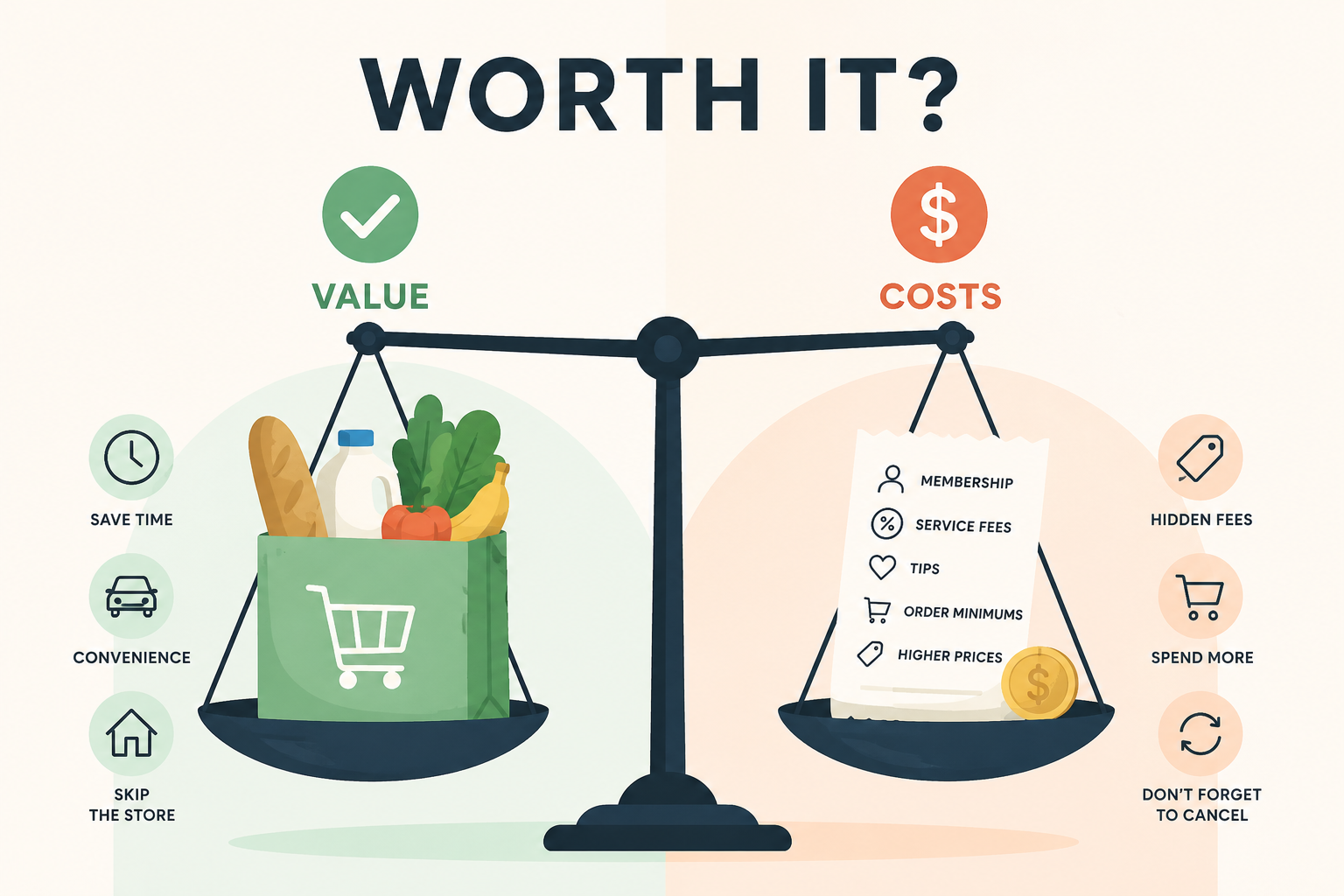
The biggest thing to remember: “free delivery” usually does not mean free groceries. You may still pay service fees, tips, order minimums, higher item prices, or add-on charges.
Quick Answer
A grocery delivery subscription is probably worth it if you order groceries at least two times per month and the membership actually replaces delivery fees you would have paid anyway.
It is probably not worth it if you are subscribing because of one promo, one busy week, or one free trial you will forget to cancel.
Popular grocery delivery memberships include Instacart+, Walmart+, Amazon’s grocery delivery subscription, and Kroger Boost. Prices, order minimums, and benefits vary by service and location.
What You Are Actually Paying For
Most grocery delivery subscriptions sell convenience in a monthly or annual wrapper.
You are usually paying for some mix of:
Free or reduced delivery fees
Lower service fees
Faster delivery windows
Fuel points or store rewards
Extra retail or streaming perks
The ability to avoid a grocery store when life is doing too much
That can be genuinely useful. It can also make spending feel less visible.
A $99 annual membership feels like one decision. But the real cost is the membership plus every order that follows.
The Main Costs to Check Before You Subscribe
1. Membership fee
Instacart+ lists a standard price of $99 per year or $9.99 per month, with $0 delivery fees on eligible orders and service fees still applying, according to Instacart’s official Instacart+ page.
Walmart+ lists $98 per year or $12.95 per month, with free delivery from your store on eligible orders and a $35 order minimum, according to Walmart’s membership help page.
Amazon says Prime members can add an optional grocery delivery subscription for $9.99 per month or $99.99 per year for unlimited grocery deliveries on eligible orders over $25 in most areas, according to Amazon’s grocery delivery explainer.
Kroger lists Boost memberships at $69 or $99 per year depending on the plan, according to Kroger’s Boost membership page.
2. Order minimums
Many memberships only waive delivery fees if your order hits a minimum. That might be $10, $25, $35, or another amount depending on the service, retailer, and location.
This matters because an order minimum can quietly encourage “I’ll just add a few things” shopping.
That is not always bad. But if you keep adding snacks, drinks, or impulse items to unlock delivery, the subscription is not saving money. It is creating a little grocery toll booth.
3. Service fees
This is the part many people miss.
A grocery membership may remove the delivery fee, but still charge service fees. The FTC’s 2025 lawsuit against Instacart alleged that “free delivery” claims were misleading when mandatory service fees still applied; Instacart agreed to a $60 million settlement without admitting wrongdoing, according to the FTC announcement.
Translation: always look at the final checkout screen, not just the membership ad.
4. Tips
Tips are usually separate from delivery fees and service fees.
That is reasonable. A person is shopping, driving, lifting, and delivering your food. But it still belongs in your math.
If each grocery order includes a $7 to $15 tip, your subscription may still be worth it for convenience, but it is not the same as “free.”
5. Item prices
Some services or retailers may have online prices that differ from in-store prices. Others advertise no item markups for certain membership deliveries.
For example, Walmart says Walmart+ store delivery includes no item markups, according to Walmart’s membership help page. With other services, check the pricing policy before assuming the cart total matches the shelf.
The Simple Break-Even Test
Use this quick formula:
Annual membership cost ÷ average delivery fee saved = number of orders needed to break even
Example:
If a membership costs $99 per year and you normally avoid a $6 delivery fee, you need about 17 orders per year to break even.
That is roughly 1.5 grocery orders per month.
But that only works if the subscription does not make you spend more than you normally would.
When Grocery Delivery Subscriptions Are Worth It
You order groceries at least twice a month
If you already order delivery regularly, a subscription can reduce repeat delivery fees.
You use the same store or platform consistently
A Walmart+ membership is more useful if Walmart is already your main grocery source. Kroger Boost makes more sense if Kroger is already your household’s default store.
You are replacing takeout
If grocery delivery helps you cook at home instead of ordering restaurant delivery, the membership may save money overall.
You have a real-life reason to avoid the store
Parents, caregivers, people without cars, disabled shoppers, night-shift workers, and overloaded households may get value that is not just financial.
Time and energy count.
When Grocery Delivery Subscriptions Are Not Worth It
You only order occasionally
If you order groceries once every few months, paying annually is probably overkill.
You place small orders
Order minimums and small-cart fees can eat the savings quickly.
You chase promos and forget renewals
Free trials are classic negative option billing: the service continues unless you actively cancel. That does not make the trial bad, but it does mean you need a reminder before the renewal date.
You impulse-shop more online
If delivery makes groceries feel like scrolling a shopping app, the convenience can backfire.
You already have too many “money-saving” memberships
A subscription that saves money only works if you use it. Otherwise, it becomes another recurring charge wearing a tiny fake mustache.
Questions to Ask Before You Subscribe
How many grocery deliveries did I place in the last 90 days?
Do not guess. Check your email receipts or app order history.
If the answer is zero or one, do not buy an annual plan yet.
Will this replace store trips or add extra orders?
A good subscription replaces friction. A bad one creates more spending opportunities.
Are service fees still charged?
Look for the final checkout total. The membership page may emphasize delivery savings, while the checkout screen tells the fuller story.
Can I cancel online?
Before starting a trial, check the cancellation path. The FTC’s negative option guidance says sellers should clearly disclose important terms, including how to cancel, according to the Federal Register notice on the Negative Option Rule.
Is the annual plan actually safer than monthly?
Annual plans are cheaper if you use them. Monthly plans are safer if you are testing the service.
For most people, monthly is the better first move. Upgrade later if the habit is real.
A Better Way to Test a Grocery Delivery Subscription
Try this before committing annually:
Use the monthly plan or free trial first.
Place two normal grocery orders.
Save the receipts.
Compare the final total with what you would have paid in-store.
Include service fees, tips, and any item price differences.
Set a calendar reminder two days before the trial or first month renews.
Cancel if it did not clearly save time, stress, or money.
The key word is “normal.” Do not test the service during one chaotic week and assume that is your everyday life forever.
The Not-Subscribed Verdict
Grocery delivery subscriptions are worth it for frequent, intentional users. They are less worth it for occasional shoppers, promo chasers, and anyone who is mainly trying to feel like they are saving money.
The best version of a grocery delivery subscription is boring: same store, regular order, clear savings, no surprise fees, easy cancellation.
The worst version is subscription sludge: a free trial turns into an annual plan, “free delivery” still has fees, and every order quietly grows because the app makes adding one more thing very easy.
Subscribe slower. Check the final total. And if the membership stops matching your real life, cancel it before it becomes just another recurring charge.
Sources
Instacart+: Membership benefits and pricing
Walmart Help: Walmart+ membership
Amazon: How to order groceries from Amazon
Kroger: Boost membership
FTC: Instacart settlement announcement
Federal Register: Negative Option Rule